
Email
Register today for the January 14 NotMiSpecies webinar: Don’t let it loose! Protecting Michigan’s waterways from pesky pets and plants
| From | MI Dept. of Environment, Great Lakes, and Energy <[email protected]> |
| Subject | Register today for the January 14 NotMiSpecies webinar: Don’t let it loose! Protecting Michigan’s waterways from pesky pets and plants |
| Date | January 3, 2025 3:31 PM |
Links have been removed from this email. Learn more in the FAQ.
Links have been removed from this email. Learn more in the FAQ.
Monthly webinar series takes an in-depth look at actions taking place to prevent the introduction and spread of invasives.
Share or view as a webpage [ [link removed] ] I Update preferences [ [link removed] ]
NotMiSpecies Web banner [ [link removed] ]
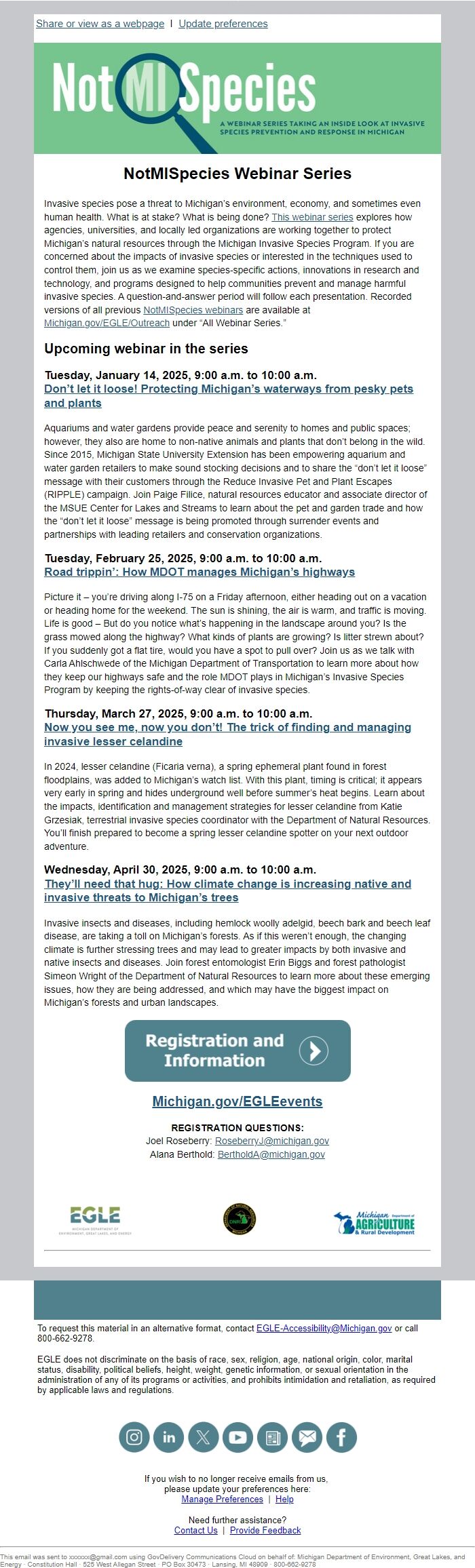
NotMISpecies Webinar Series
Invasive species pose a threat to Michigan’s environment, economy, and sometimes even human health. What is at stake? What is being done? This webinar series [ [link removed] ] explores how agencies, universities, and locally led organizations are working together to protect Michigan’s natural resources through the Michigan Invasive Species Program. If you are concerned about the impacts of invasive species or interested in the techniques used to control them, join us as we examine species-specific actions, innovations in research and technology, and programs designed to help communities prevent and manage harmful invasive species. A question-and-answer period will follow each presentation. Recorded versions of all previous NotMISpecies webinars [ [link removed] ] are available at Michigan.gov/EGLE/Outreach [ [link removed] ] under “All Webinar Series.”
Upcoming webinar in the series
*Tuesday, January 14, 2025, 9:00 a.m. to 10:00 a.m.
Don’t let it loose! Protecting Michigan’s waterways from pesky pets and plants [ [link removed] ]*
Aquariums and water gardens provide peace and serenity to homes and public spaces; however, they also are home to non-native animals and plants that don’t belong in the wild. Since 2015, Michigan State University Extension has been empowering aquarium and water garden retailers to make sound stocking decisions and to share the “don’t let it loose” message with their customers through the Reduce Invasive Pet and Plant Escapes (RIPPLE) campaign. Join Paige Filice, natural resources educator and associate director of the MSUE Center for Lakes and Streams to learn about the pet and garden trade and how the “don’t let it loose” message is being promoted through surrender events and partnerships with leading retailers and conservation organizations.
*Tuesday, February 25, 2025, 9:00 a.m. to 10:00 a.m.
Road trippin’: How MDOT manages Michigan’s highways [ [link removed] ]*
Picture it – you’re driving along I-75 on a Friday afternoon, either heading out on a vacation or heading home for the weekend. The sun is shining, the air is warm, and traffic is moving. Life is good – But do you notice what’s happening in the landscape around you? Is the grass mowed along the highway? What kinds of plants are growing? Is litter strewn about? If you suddenly got a flat tire, would you have a spot to pull over? Join us as we talk with Carla Ahlschwede of the Michigan Department of Transportation to learn more about how they keep our highways safe and the role MDOT plays in Michigan’s Invasive Species Program by keeping the rights-of-way clear of invasive species.
*Thursday, March 27, 2025, 9:00 a.m. to 10:00 a.m.
Now you see me, now you don’t! The trick of finding and managing invasive lesser celandine [ [link removed] ]*
In 2024, lesser celandine (Ficaria verna), a spring ephemeral plant found in forest floodplains, was added to Michigan’s watch list. With this plant, timing is critical; it appears very early in spring and hides underground well before summer’s heat begins. Learn about the impacts, identification and management strategies for lesser celandine from Katie Grzesiak, terrestrial invasive species coordinator with the Department of Natural Resources. You’ll finish prepared to become a spring lesser celandine spotter on your next outdoor adventure.
*Wednesday, April 30, 2025, 9:00 a.m. to 10:00 a.m.
They’ll need that hug: How climate change is increasing native and invasive threats to Michigan’s trees [ [link removed] ]*
Invasive insects and diseases, including hemlock woolly adelgid, beech bark and beech leaf disease, are taking a toll on Michigan’s forests. As if this weren’t enough, the changing climate is further stressing trees and may lead to greater impacts by both invasive and native insects and diseases. Join forest entomologist Erin Biggs and forest pathologist Simeon Wright of the Department of Natural Resources to learn more about these emerging issues, how they are being addressed, and which may have the biggest impact on Michigan’s forests and urban landscapes.
Registration button EGLE Blue [ [link removed] ]
Michigan.gov/EGLEevents [ [link removed] ]
*REGISTRATION QUESTIONS:*
Joel Roseberry: [email protected] <[email protected]>
Alana Berthold: [email protected]
AIS agency footer
________________________________________________________________________
To request this material in an alternative format, contact [email protected] or call 800-662-9278.
EGLE does not discriminate on the basis of race, sex, religion, age, national origin, color, marital status, disability, political beliefs, height, weight, genetic information, or sexual orientation in the administration of any of its programs or activities, and prohibits intimidation and retaliation, as required by applicable laws and regulations.
Instagram [ [link removed] ] Linkedin [ [link removed] ] X [ [link removed] ] YouTube [ [link removed] ] MiEnvironment [ [link removed] ] GovDelivery [ [link removed] ] Facebook [ [link removed] ]
If you wish to no longer receive emails from us,
please update your preferences here:
Manage Preferences [ [link removed] ] | Help [ [link removed] ]
Need further assistance?
Contact Us <[email protected]> | Provide Feedback <[email protected]>
________________________________________________________________________
This email was sent to [email protected] using GovDelivery Communications Cloud on behalf of: Michigan Department of Environment, Great Lakes, and Energy · Constitution Hall · 525 West Allegan Street · PO Box 30473 · Lansing, MI 48909 · 800-662-9278
Share or view as a webpage [ [link removed] ] I Update preferences [ [link removed] ]
NotMiSpecies Web banner [ [link removed] ]
NotMISpecies Webinar Series
Invasive species pose a threat to Michigan’s environment, economy, and sometimes even human health. What is at stake? What is being done? This webinar series [ [link removed] ] explores how agencies, universities, and locally led organizations are working together to protect Michigan’s natural resources through the Michigan Invasive Species Program. If you are concerned about the impacts of invasive species or interested in the techniques used to control them, join us as we examine species-specific actions, innovations in research and technology, and programs designed to help communities prevent and manage harmful invasive species. A question-and-answer period will follow each presentation. Recorded versions of all previous NotMISpecies webinars [ [link removed] ] are available at Michigan.gov/EGLE/Outreach [ [link removed] ] under “All Webinar Series.”
Upcoming webinar in the series
*Tuesday, January 14, 2025, 9:00 a.m. to 10:00 a.m.
Don’t let it loose! Protecting Michigan’s waterways from pesky pets and plants [ [link removed] ]*
Aquariums and water gardens provide peace and serenity to homes and public spaces; however, they also are home to non-native animals and plants that don’t belong in the wild. Since 2015, Michigan State University Extension has been empowering aquarium and water garden retailers to make sound stocking decisions and to share the “don’t let it loose” message with their customers through the Reduce Invasive Pet and Plant Escapes (RIPPLE) campaign. Join Paige Filice, natural resources educator and associate director of the MSUE Center for Lakes and Streams to learn about the pet and garden trade and how the “don’t let it loose” message is being promoted through surrender events and partnerships with leading retailers and conservation organizations.
*Tuesday, February 25, 2025, 9:00 a.m. to 10:00 a.m.
Road trippin’: How MDOT manages Michigan’s highways [ [link removed] ]*
Picture it – you’re driving along I-75 on a Friday afternoon, either heading out on a vacation or heading home for the weekend. The sun is shining, the air is warm, and traffic is moving. Life is good – But do you notice what’s happening in the landscape around you? Is the grass mowed along the highway? What kinds of plants are growing? Is litter strewn about? If you suddenly got a flat tire, would you have a spot to pull over? Join us as we talk with Carla Ahlschwede of the Michigan Department of Transportation to learn more about how they keep our highways safe and the role MDOT plays in Michigan’s Invasive Species Program by keeping the rights-of-way clear of invasive species.
*Thursday, March 27, 2025, 9:00 a.m. to 10:00 a.m.
Now you see me, now you don’t! The trick of finding and managing invasive lesser celandine [ [link removed] ]*
In 2024, lesser celandine (Ficaria verna), a spring ephemeral plant found in forest floodplains, was added to Michigan’s watch list. With this plant, timing is critical; it appears very early in spring and hides underground well before summer’s heat begins. Learn about the impacts, identification and management strategies for lesser celandine from Katie Grzesiak, terrestrial invasive species coordinator with the Department of Natural Resources. You’ll finish prepared to become a spring lesser celandine spotter on your next outdoor adventure.
*Wednesday, April 30, 2025, 9:00 a.m. to 10:00 a.m.
They’ll need that hug: How climate change is increasing native and invasive threats to Michigan’s trees [ [link removed] ]*
Invasive insects and diseases, including hemlock woolly adelgid, beech bark and beech leaf disease, are taking a toll on Michigan’s forests. As if this weren’t enough, the changing climate is further stressing trees and may lead to greater impacts by both invasive and native insects and diseases. Join forest entomologist Erin Biggs and forest pathologist Simeon Wright of the Department of Natural Resources to learn more about these emerging issues, how they are being addressed, and which may have the biggest impact on Michigan’s forests and urban landscapes.
Registration button EGLE Blue [ [link removed] ]
Michigan.gov/EGLEevents [ [link removed] ]
*REGISTRATION QUESTIONS:*
Joel Roseberry: [email protected] <[email protected]>
Alana Berthold: [email protected]
AIS agency footer
________________________________________________________________________
To request this material in an alternative format, contact [email protected] or call 800-662-9278.
EGLE does not discriminate on the basis of race, sex, religion, age, national origin, color, marital status, disability, political beliefs, height, weight, genetic information, or sexual orientation in the administration of any of its programs or activities, and prohibits intimidation and retaliation, as required by applicable laws and regulations.
Instagram [ [link removed] ] Linkedin [ [link removed] ] X [ [link removed] ] YouTube [ [link removed] ] MiEnvironment [ [link removed] ] GovDelivery [ [link removed] ] Facebook [ [link removed] ]
If you wish to no longer receive emails from us,
please update your preferences here:
Manage Preferences [ [link removed] ] | Help [ [link removed] ]
Need further assistance?
Contact Us <[email protected]> | Provide Feedback <[email protected]>
________________________________________________________________________
This email was sent to [email protected] using GovDelivery Communications Cloud on behalf of: Michigan Department of Environment, Great Lakes, and Energy · Constitution Hall · 525 West Allegan Street · PO Box 30473 · Lansing, MI 48909 · 800-662-9278
Message Analysis
- Sender: Michigan Department of Environment, Great Lakes, and Energy
- Political Party: n/a
- Country: n/a
- State/Locality: n/a
- Office: n/a
-
Email Providers:
- govDelivery