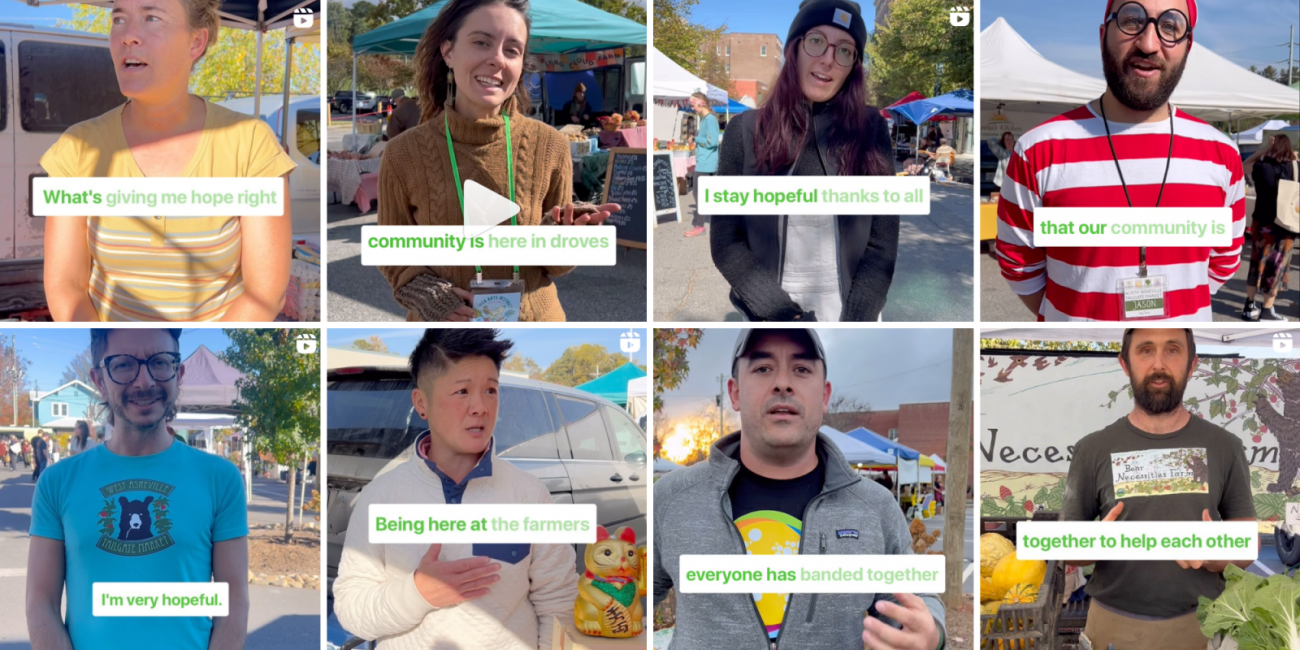
This year, we're asking the people in our community—farmers, market managers, food producers, shoppers, educators—what is bringing them hope. "I love how community is rallying around local foods," says Jason Mogen, executive director of North Asheville Tailgate Market. "We have a lot of farms impacted by Helene. They are showing up as much as they can and bringing fresh ingredients from our community back into Asheville. We are getting support from organizations like ASAP to ensure people can benefit from our Farm Fresh Bucks [ASAP’s Double SNAP program].” You can follow along on our Instagram to watch more of these highlights and share them with your networks!
The path to recovery will be long. So much feels urgent right now—education about Disaster SNAP and other community aid; talking one-on-one with farmers to connect them with the right programs to help them; garnering resources to distribute. But we don’t yet know what the long-term impacts will be. This generational storm leaves changed topography and waterways, topsoil loss, and economic uncertainty, particularly for restaurants and hospitality businesses. What we do know: ASAP is working to support farms and the community now, and will be here for the long haul.
A gift today and through Giving Tuesday sustains ASAP's work for the future. It helps farmers rebuild. It ensures that our neighbors have access to fresh, local produce. Please support ASAP this Giving Tuesday!
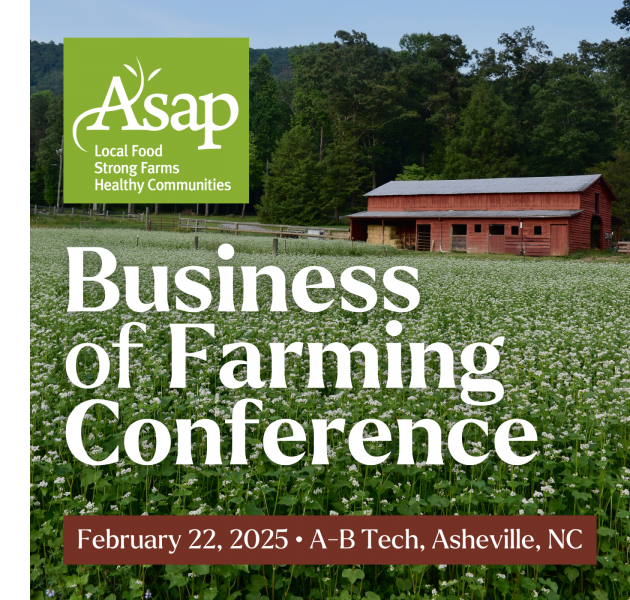
Registration Is Open for Business of Farming Conference
ASAP’s annual Business of Farming Conference brings together professional farmers from across the Southeast region to network and share resources to grow their farm businesses. Farmers learn about marketing, business planning, and financial management from regional experts and innovative peers. The conference is designed for beginning and established farmers as well as those seriously considering farming as a profession. This year's conference will have a specific focus on recovery and resilience.
Does your business offer products or services for farmers? Consider sponsoring or exhibiting at the conference! A sponsorship showcases you as a leader of the local food movement, ensuring that farmers have the tools they need to grow and thrive. Both sponsors and exhibitors receive table space in the conference exhibitor hall to connect with more than 200 farmers at all stages of their careers. Email nscheff@asapconnections.org to find out more about opportunities.
Farmer to Farmer Webinar: Navigating Federal Farm Recovery Programs Offered by FSA and NRCS
ASAP is facilitating a farmer learning cohort to focus on Helene recovery. This series of webinars will allow farmers to share experiences, learn from one another about navigating recovery resources, and document learnings for fellow farmers and future needs. The first webinar—Thursday, Nov. 21, from 2 to 4 p.m.—will focus on programs by Farm Service Agency and Natural Resources Conservation Service. Farmer presenters include Mary Carroll Dodd of Red Scout Farm in Black Mountain, NC, and Danielle Hutchison of TendWell Farm in Old Fort, NC. Participation in the webinars is free, but registration is required. Appalachian Grown certified farms will be compensated for their time to attend.
FACES OF LOCAL
Mike Bean
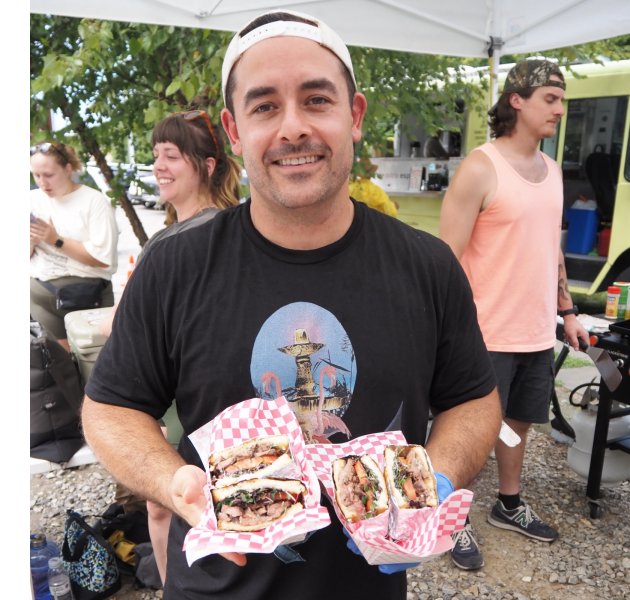
Mike Bean is a local chef with Finest Deli (though temporarily on hold) serving up fresh eats at farmers markets in Buncombe County. He serves on On Track WNC‘s Board of Directors and quickly shifted his cooking skills to support meal operations with World Central Kitchen to keep the people of Western North Carolina fed in the wake of Helene. Mike is a big advocate for empathy, sandwiches, and ingredient sourcing from local farms.
What gets you excited about preparing meals made with local ingredients? What has made it possible for you to do so?
The first part is that we always want to serve the most delicious food. Using locally grown ingredients—grown, produced, raised by people that we know and trust—just tastes better. I barely shop at grocery stores now because all the produce is just so much better here. Whether it’s something that is special to you, like Black Trumpet Farm’s gray oyster mushrooms or whether it’s something that is looked down on as a cheap food like J4 Cattle ground beef—our food tastes better because we use local ingredients. Why are we able to do it? Because we have an awesome local network of producers who are passionate about their food and are passionate about feeding people. We want to put together these beautiful meals, but do it at an approachable price point. Jay and Gwen of Black Trumpet are psyched to see that we put together a mushroom sandwich every week. Normally, their mushrooms are so exquisite that they are most often used at high-end restaurants. We can put something out that is affordable for every day.
You clearly love to feed people—is that why you started Finest Deli?
I do. In high school to college to now, I’ve always hosted family dinners with friends. When I worked in media telecommunications, I would still host big dinner parties. When I had a change in my career, I was deciding what it is that I wanted to do, and feeding people was very near the top of my list. They say you should write what you know—I know food and I know feeding people. Some of it is selfish! I want better sandwiches around town. I think that we make some pretty banging sandwiches, and it’s even better when you use the local goods.
What are your favorite foods to prepare?
We do a really good chopped cheese made with J4 cattle 24-day dry-aged ground beef raised out of Morganton. Anna and her family raise some beautiful cows. That’s a sandwich I picked up when I lived in New York City and we brought it here. We get a lot of people who come through for the chopped cheese specifically. We use Lee’s One Fortune Farm tomatoes and greens.
We do a shroom filet that’s our veg spin on that famous chicken chain that not everyone is a big fan of. So, we do a shroom filet that is a Cajun-seasoned lions mane grilled up with Serotonin Ferments pickles and house-made honey mustard that we make with Wilderkin Beekeeping honey. Sometimes we’ll have folks come and get it Tuesday and then Wednesday. If you’re feeding someone the same sandwich two days in a row and they come back week after week, we’re doing something right.
Also, our pork green chile which is a personal favorite. We do a breakfast burrito version using Dry Ridge Farm pork and eggs, Tiny Bridge Farm green chiles, Flying Cloud Farm onions and other peppers. That’s like a Denver, New Mexico specialty. We worked with Ed [Graves of Tiny Bridge] to raise those green chiles specially here in North Carolina. Early on at the market I mentioned it to him that I love green chiles and he said that it was going to be a pet project for him. He dedicated a big portion of his field to my green chiles, which made me so happy.
At the start of Helene, what brought you to pivot to cook with World Central Kitchen (WCK)?
I love feeding people and I love helping people. I was able to combine those things and provide relief and nourishment—really build community through food, which is so powerful. It’s almost difficult to talk about, but it is something that I believe in so strongly. The people that operate WCK are truly some of the most caring people I have ever met. They help you set up this huge, high-powered, logistical cook and distribution operation, but all of it is rooted in caring for the community and helping people not focus so much on figuring out how to get their food needs met.
We found this farm off of Route 19 in Burnsville—they were absolutely devastated. They hadn’t had a hot meal since the storm, which was over a week. No one had been in to visit them. They were eating cold canned goods. We got them connected to food the next day, and then we connected the hundred people or so that live in their holler. Now they all know each other by name. They ate dinners together in some of the toughest times in their lives when they were dealing with property loss, loss of life, and disruption to their lives. Our food got them to connect with each other in a way that they never have before. It was absolutely one of the most beautiful moments I have ever seen.
What’s the future of Finest Deli?
Well, Finest Deli, we got our start here at the West Asheville Tailgate Market with Vinny along with Lyric over at River Arts District Farmers Market and we will absolutely be coming back to these markets as soon as my mission with WCK gets to a stable place. While things are improving rapidly, there are still huge needs in Swannanoa and Black Mountain. The permanent WCK staff is leaving in the next week or so, so I’m going to be managing the phase out and transition to long-term feeding. I’m happy that I get to do it. I’d rather be responsible for the tough hard work than wonder what’s going on with it. When the time is right we will definitely be back at markets.
Hopefully, we will have some other good news to share in the near future. Follow us on Instagram at @finestavl and maybe you will learn a little bit more. It should be good news but I promise it will all be rooted in local food sourcing and community meals. We want to get people together for beautiful, nourishing, delicious, delicious at all roots in delicious, food that is affordable and approachable.
RECIPE OF THE MONTH
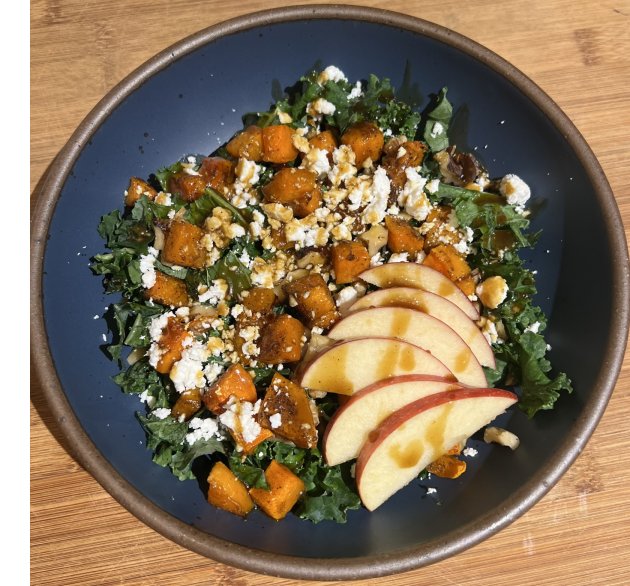
Kale, Apple, and Butternut Salad
You can eat butternut squash all fall and winter long. This vegetable’s tough skin makes it a perfect storage crop. Butternuts are loaded with Vitamin A—hence their orange color—along with Vitamin C, magnesium, and potassium. Winter squash are native from the eastern United States to as far south as Argentina, and are one of the companion plants in the indigenous Three Sisters gardening method.
Salad
4-6 kale leaves, de-stemmed and chopped
1 medium butternut squash, peeled and cubed
1/2 cup nuts, such as pecans, walnuts, pumpkin seeds, almonds
2 small apples, sliced or cubed
1/2 cup crumbled cheese such as feta, goat cheese, or parmesan
1 tablespoon olive oil
1/2 teaspoon garlic powder
1/2 teaspoon salt
1/2 teaspoon black pepper
1/2 teaspoon paprika
Salad
1 tablespoon balsamic vinegar
1 tablespoon mustard
2 tablespoons olive oil
1/2 tablespoon local honey or maple syrup
1/4 teaspoon salt
1/4 teaspoon black pepper
Directions
Preheat your oven to 425 degrees F and oil a baking sheet. Add cubed butternut squash and season with salt, oil, and spices. Feel free to add other spices according to your taste! Roast until tender, about 20 minutes. Remove and let cool.
Whisk together all dressing ingredients and set aside.
Chop kale, nuts, and apples and combine with cooled butternut squash. Top with cheese of choice and drizzle on dressing.
“It’s difficult if you’re not in this ag resource world to know what’s out there, so making sure folks sit down with somebody or get on the phone with somebody and spend some time learning about what all they can access. There’s a good amount out there but it’s tricky to know what all is there.”




 RECIPE OF THE MONTH