

Dissolving Illusions is supposed to be a book about 'Disease, Vaccines, and Forgotten History.'
"Using myth-shattering graphs, this book shows that vaccines, antibiotics, and other medical interventions are not responsible for the increase in lifespan and the decline in mortality from infectious diseases."
Dissolving Illusions by Suzanne Humphries
Instead, you will quickly see that it should be thrown away and forgotten by anyone who truly wants to learn about vaccines and vaccine-preventable diseases.
The First Five Errors in Dissolving Illusions by Suzanne Humphries
So what's wrong with Dissolving Illusions?
"The book contains more than 50 graphs that are based on meticulously researched data. Each graph lists the references upon which the data is based. The graphs provide—in most cases—a never-before-seen view of the history of disease from the 1800s into the 1900s. They provide foundational evidence for the points presented in the text.”
Dissolving Illusions by Suzanne Humphries
Well, let's take a look at one of those graphs.
Suzanne Humphries claims that the "This following diagram reveals the parallel between polio epidemics in the United States and tonnage of pesticide (most of which was DDT) production from 1940 to 1970."
She thinks that it proves a correlation between the production of pesticides and cases of polio.

There is a problem though!

Her little graph doesn't correlate with data on either production or use of DDT from the EPA!

In fact, it is very easy to see that DDT use, which peaked in 1959, doesn't correlate with polio cases (which peaked in 1952) at all!
So go ahead and pull out the pages from her book that blame DDT for our polio epidemics. And while you are at it, you can throw out those sections of most other anti-vaccine books, like Turtles All The Way Down and that moth book.
You are going to want to take another look at all of the cherry picked quotes she uses throughout the book too...
"The format of this book is somewhat unconventional, as it is filled with many direct quotes from a wide variety of historical and medical sources. We decided on this format to give you unfiltered information that will help you gain better insight into the true history of disease and vaccination. Oftentimes each quote tells a unique, self-contained story that can draw the reality of the past into view much better than a distilled summary would.”
Dissolving Illusions by Suzanne Humphries
Let's see what she says about inoculation for smallpox.
"A 1764 article made it clear that the unintended result of inoculation was an increased death rate from smallpox.”
Dissolving Illusions by Suzanne Humphries
Since the anti-vaccine movement started with inoculation, even before we had our first vaccine, it's not surprising that Suzanne Humphries found an article (it is just an unsigned letter...) supporting her agenda, that vaccines are dangerous and aren't necessary.
"It does not follow Inoculation is a practice favourable to life… It is incontestably like the plague a contagious disease, what tends to stop the progress of the infection tends to lessen “the danger that attends it; what tends to spread the contagion, tends to increase that danger; the practice of Inoculation manifestly tends to spread the contagion, for a contagious disease is produced by Inoculation where it would not otherwise have been produced; the place where it is thus produced becomes a center of contagion, whence it spreads not less fatally or widely than it would spread from a center where the disease should happen in a natural way; these centers of contagion are manifestly multiplied very greatly by Inoculation…”
Dissolving Illusions by Suzanne Humphries
The letter writer thought you could easily avoid smallpox by leaving town during an outbreak and seemed to be against variolation for smallpox because he was afraid it would spread smallpox to others.
"It seems, therefore, to follow by necessary consequence, that before Inoculation can be favourable to life in general, some effectual method must be taken to prevent it from spreading the natural small pox."
The Gentleman's Magazine 1764-07: Vol 34 Iss 7. p 332-33.
While it was true that folks were contagious after they were inoculated, fortunately, they had a method to keep others from getting sick.
Those who were inoculated against smallpox were supposed to stay in quarantine! That seems more practical than leaving town, especially if you didn't have an estate in the countryside to escape to.
What else?
"In 1736 I lost one of my sons, a fine boy of four years old, by the smallpox, taken in the common way. I long regretted bitterly, and still regret that I had not given it to him by inoculation. This I mention for the sake of parents who omit that operation, on the supposition that they should never forgive themselves if a child died under it; my example showing that the regret may be the same either way, and that, therefore, the safer should be chosen.”
Benjamin Franklin
A lot of people at the time thought very highly of variolation!
"Medical article after medical article pointed out clearly that exposure to cowpox providing lifelong immunity to smallpox was an unproven theory."
Dissolving Illusions by Suzanne Humphries
And the medical articles she cites?
They are mostly cherry picked books and letters from 19th century anti-vaccine influencers, like Alfred Russel Wallace.

If you instead look at a careful analysis of smallpox mortality in London from 1664 to 1930, you can clearly see that the smallpox vaccine works very well!
Not surprisingly, this isn't in her book though...
She even pushes the myth that the Leicester Method eliminated the need for vaccination.

Of course, it didn't!
In fact, it popularized the ring vaccination method that helped us finally eradicate smallpox!
Propaganda All The Way Down
What's the rest of the book about?
It's filled with mortality graphs that she thinks prove that vaccine-preventable diseases all went away without vaccines, mostly because of improved sanitation and hygiene.
And while it is true that improved sanitation and hygiene had a very big effect on mortality rates in the early part of the 20th century, the big drops in deaths mostly stalled in the 1930s to early 40s.
Anti-vaccine folks commonly use these types of mortality graphs to hide the fact that a lot of people were still getting and dying of now vaccine-preventable diseases in the middle of the 20th century.
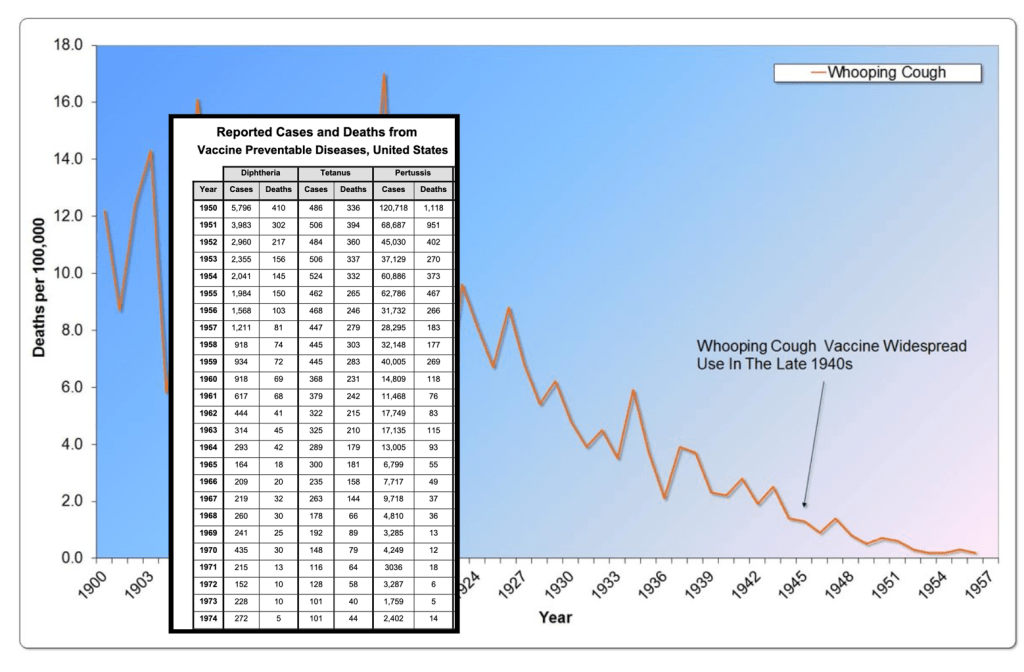
It's pure propaganda and a trick to make you think that vaccines aren't necessary and don't work.
As you have already seen, it is just one of many tricks she uses.
You can see yet another when she talks about polio. In addition to blaming DDT, she says that we don't see polio anymore because we changed it's name and we now have ventilators instead of iron lungs!
Of course, this is all easily debunked.
As is everything else in Dissolving Illusions!
Her view that SSPE, a life-threatening complication of a natural measles infection, is a disease of the vaccinated?
"Contrary to popular belief, SSPE is now a disease of the vaccinated."
Dissolving Illusions by Suzanne Humphries
It comes from cherry picking a few case reports and ignoring the great majority of evidence that says measles vaccines not only do not cause SSPE, but very definitively say that they are the best way to help your child avoid SSPE.
"The incidence of SSPE dropped sharply in 1977, 10 years (the median age at onset of SSPE) after introduction of mass antimeasles vaccination, and remained low in 1978 and 1979. Most of the SSPE cases reported measles at an age significantly younger than that of the general population. This pattern did not change after introduction of antimeasles vaccination. Incidence was significantly lower (p < 10−9) in the vaccinated population than in the unvaccinated population. Occurrence of SSPE in some children who were vaccinated against measles could be explained by incomplete vaccine efficacy, or by older age at vaccination, which allows the possibility of prior exposure to measles. There was no indication that measles vaccine can induce SSPE."
Measles, measles vaccination, and risk of subacute sclerosing panencephalitis (SSPE)
If SSPE is caused by measles vaccines, why has the incidence of SSPE dropped so much as more and more kids have gotten vaccinated and protected against measles?
"In the big picture, the belief that vaccines were instrumental in changing our world from a disease-plagued horror to our modern environment is not reflected by the evidence."
Dissolving Illusions by Suzanne Humphries
Suzanne Humphries doesn't think that vaccines work and that they aren't necessary. If that were true though, that why do vaccine preventable diseases always return whenever vaccination rates drop?
Of course, it's because she is very wrong. Vaccines work well and they are necessary and safe.
What to Know About Dissolving Illusions
Dissolving Illusions is pure anti-vaccine propaganda that uses quotes from ancient anti-vaccine sources and does a lot of cherry picking to try to make you think that vaccines don't work and aren't necessary. Unless you are simply looking for a reason to justify not vaccinating your children and leaving them at risk to get a vaccine-preventable disease, skip this book, or at least read it with a very skeptical eye, checking each claim and reference.
More on Suzanne Humphries
- Graphs That Show Vaccines Don’t Work
- Did the Measles Vaccine Have Only a Meager Effect on Deaths?
- Did Better Hygiene and Sanitation Get Rid of Vaccine-Preventable Diseases?
- Benjamin Franklin Regretted Letting His Son Die of Smallpox
- Patterns of smallpox mortality in London, England, over three centuries
-
Measles, measles vaccination, and risk of subacute sclerosing panencephalitis (SSPE)
Throwback Bad Chart Thursday: The TRUTH about Bad Measles Charts the Mainstream Media Is Suppressing - Dr. Suzanne Humphries and the International Medical Council on Vaccination: Antivaccine to the core
- Quoth Dr. Suzanne Humphries: Vaccines are “disease matter”
- The intellectual dishonesty of the “vaccines didn’t save us” gambit
- Analysis of Anti-Vax Graphs
- Yes, vaccines did save us from disease: a graphic analysis
- Pre-Vaccine Declines in Measles Mortality


