|  | Know better. Do better. |  | Climate. Change.News from the ground, in a warming world |
|
| | | By Jack Graham | Climate change and nature correspondent, UK | | |
|  |
| Elusive climate financeHowever much the world cuts greenhouse gas emissions, the science is clear that climate change will have an increasing impact on our lives.
Yet the world spends nowhere near enough on adaptation measures like flood defences and resilient crops. Developing countries need at least 10 times more finance, the U.N. says.
At COP28, we broke the story that pledges were falling well short for a key adaptation fund as attention shifts to a new "loss and damage" fund.
And this week in Dhaka, my colleague Md. Tahmid Zami reports that the situation might be even worse than previously thought.
New research by Oxfam says the Asian Development Bank (ADB) "hugely overstated" adaptation funds provided to vulnerable countries, by as much as 44% in the projects examined.
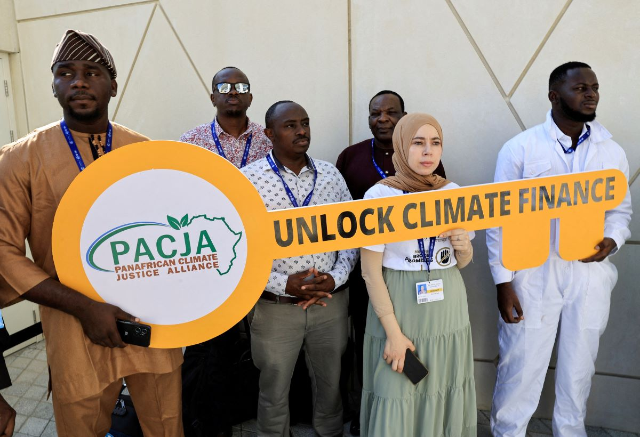 Activists hold a sign that reads "Unlock Climate Finance" at the United Nations Climate Change Conference COP28 in Dubai, United Arab Emirates, December 5, 2023. REUTERS/Thaier Al-Sudani |
The ADB - a major funder of climate-vulnerable countries - stood by its reported figures, saying the charity was using a different methodology.
Whoever is right, climate finance experts are increasingly concerned about inflated figures and projects being mislabelled as climate finance.
A Reuters investigation last year found that some such finance was going to "strange places" like building a coal plant, a hotel, chocolate stores, making a movie and an airport expansion.
Rich countries pledged to provide $100 billion in climate finance a year by 2020, but "it has still remained as elusive as a golden deer," said Mizan Khan, deputy director of Dhaka-based climate think tank International Centre for Climate Change and Development (ICCCAD).
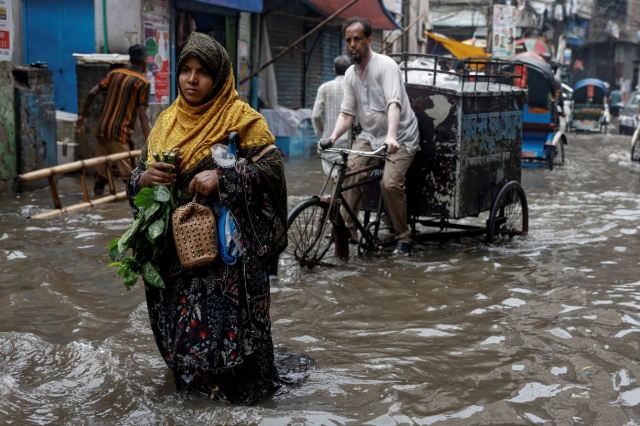 A woman walks along a flooded street after heavy rain, in Dhaka, Bangladesh, June 12, 2023. REUTERS/Mohammad Ponir Hossain |
Borrowed timeFor those in Bangladesh and other nations heavily impacted by climate change, it's not just the amount of climate finance that matters.
Developing countries have called for major funders like the Green Climate Fund - the world's largest such fund - to provide more grants instead of loans, or at least “soft” loans with lower interest rates and longer repayment periods.
Otherwise, countries will have to spend more money servicing loans than channelling funds to healthcare or social protection, said Sunil Acharya, Oxfam's Asia regional policy and campaigns coordinator.
Currently, developing nations get about 80% of adaptation finance as loans and just 20% in grants, according to Khan from ICCCAD.
"This is where least developed countries lose out," he said.
I'll be off for the next couple of weeks, leaving you in the capable hands of my colleague Bhasker Tripathi.
See you soon,
Jack |
|
|
| | With heatwaves roasting cities, chief heat officers try to protect people from temperatures so high 'the body can't cool down' | Backers say rice variety is a cheap way to fix vitamin A deficiency, but Philippine court ruling could delay sowing in Bangladesh | With heatwaves roasting cities, chief heat officers try to protect people from temperatures so high 'the body can't cool down' | |
| |
| | | |
|


