

On Memorial Day we honor and mourn the U.S. military personnel who died while serving in the United States Armed Forces.
What does that have to do with vaccines or vaccine preventable diseases?
This Memorial Day Remember Those Who Lost the Fight to Now Vaccine Preventable Diseases
Believe it or not, until fairly recently, the biggest killer when you were in the military wasn't combat.
"Throughout America's first 145 years of war, far more of the country's military personnel perished from infectious diseases than from enemy action."
Two faces of death: fatalities from disease and combat in America's principal wars, 1775 to present
The biggest enemy was often infectious diseases - most of which are now vaccine-preventable.
“Finding the smallpox to be spreading much and fearing that no precaution can prevent it from running thro’ the whole of our Army, I have determined that the Troops shall be inoculated. This Expedient may be attended with some inconveniences and some disadvantages, but yet I trust, in its consequences will have the most happy effects. Necessity not only authorizes but seems to require the measure, for should the disorder infect the Army, in the natural way, and rage with its usual Virulence, we should have more to dread from it, than from the sword of the enemy.”
"Massachusetts House of Representatives, October 5, 1775, Smallpox Resolution," George Washington Papers, Series 4, General Correspondence, Library of Congress.
That's what led General George Washington, in 1777, to mandate that every soldier in the Continental Army had to be inoculated.
Washington was concerned about his troops getting smallpox.
And he had a good reason to be concerned.
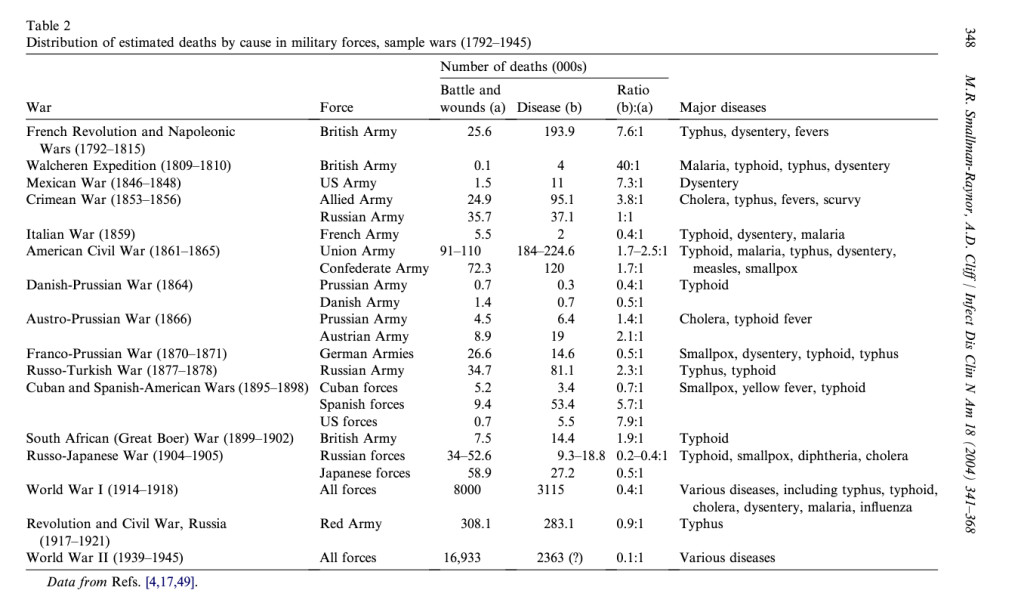
smallpox, typhoid, typhus, influenza, malaria, measles,
relapsing fever, and yellow fever.
In the Disease Era, before World War II, infectious diseases were the major killer of those in the military, including:
- smallpox - vaccine developed in 1796
- typhoid fever - vaccine developed in 1896
- cholera - vaccine developed in 1896
- plague - vaccine developed in 1897
- diphtheria - vaccine first developed in 1913
- tetanus - vaccine developed in 1927
- typhus - vaccine developed in 1933
- yellow fever - vaccine developed in 1936
- influenza - vaccine developed in 1945
- measles - vaccine first developed in 1963
- dysentery
- malaria
What happened in World War II?
"Entering World War II, U.S. troops were immunized against smallpox, typhoid fever, cholera, plague, tetanus, yellow fever, and typhus."
Two Faces of Death: Fatalities from Disease and Combat in
America's Principal Wars, 1775 to Present
By World War II, several vaccines had been developed to help protect the troops.
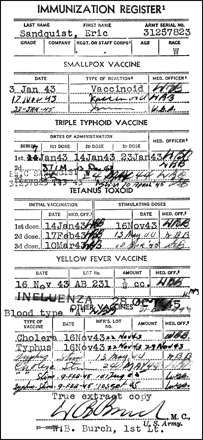
Unfortunately, as science helped us keep our troops safe from disease, it also helped us get better at killing each other. So troops kept dying as we entered the Trauma Era of war.
"The British Army used early forms of typhoid vaccine during the Anglo-Boer War in southern Africa in 1899. Among 14,626 immunized British soldiers, there were 1,417 cases of typhoid fever and 163 deaths (11 of 1,000 soldiers). In contrast, among 313,618 unimmunized soldiers, there were 48,754 cases and 6,991 deaths (32 of 1,000)."
Immunization to Protect the US Armed Forces: Heritage, Current Practice, and Prospects
And sure, better hygiene and sanitation was certainly a factor in reducing many of these diseases in the early 20th century.
"Improved sanitation reduced disease casualties in World War I, but it could not protect troops from the 1918 influenza pandemic. During the outbreak, flu accounted for roughly half of US military casualties in Europe."
How World War II spurred vaccine innovation
It wasn't the only factor though.
"Only 12 cases of tetanus were reported throughout World War II, from all theaters of operations, despite more than 12 million Americans in uniform who incurred more than 2.7 million hospital admissions for wounds or injuries. All 12 cases were in unimmunized or incompletely immunized troops."
Immunization to Protect the US Armed Forces: Heritage, Current Practice, and Prospects
This Memorial Day, let's not forget the important role vaccines play in keeping our military safe and healthy. Let's also remember all of those who died with diseases that we are fortunate are now preventable with safe and effective vaccines.
More on War and Disease
- Mumps on the USS Fort McHenry
- Vaccines and Gulf War Syndrome
- How Do You Remember Vaccine Preventable Diseases?
- Remembering Measles
- Grave Reminders of Life Before Vaccines
- Founding Fathers on Vaccines
- Memorial Day history
- Memorial Day: A Commemoration
- Memorial Day: Remembering Our Troops' Most Lethal Enemy
- War and infectious diseases: brothers in arms
- How World War II spurred vaccine innovation
- History of U.S. military contributions to the study of vaccines against infectious diseases
- "Massachusetts House of Representatives, October 5, 1775, Smallpox Resolution," George Washington Papers, Series 4, General Correspondence, Library of Congress.
- Two faces of death: fatalities from disease and combat in America's principal wars, 1775 to present
- Impact of infectious diseases on war
- Immunization to Protect the US Armed Forces: Heritage, Current Practice, and Prospects
- Mortality Surveillance in the U.S. Army, 2014–2019
- Typhus, War, and Vaccines
- U.S. Military and Vaccine History
- Vaccines in the Time of War
- How Scientists Created A Typhus Vaccine In A ‘Fantastic Laboratory’
- U.S. Military Immunization: The Fight against Infectious Diseases
- Re-Emerging Vaccine-Preventable Diseases in War-Affected Peoples of the Eastern Mediterranean Region—An Update


