|



In my last post, I shared a Memorial Day speech that began with the story of a phone call from my daughter. In another speech, a year later, I began with the story of a fellow warrior of immense talent and promise. In re-reading those speeches, I discovered a common theme of civility in our social discourse. Of course, no part of that discourse is as coarse as it is in politics, and no part of the federal government has set the bar lower than the U.S. House of Representatives. But it can be better. It doesn't take a floor debate to fix. Taking care to engage with others in good faith is something we commit to as individuals. Those we honor on Memorial Day deserve better.
Two weeks after Memorial Day in 1996, I transferred from my first Fleet Marine Force tour to a shore billet as Tenth Company Officer at the U.S. Naval Academy in Annapolis, Maryland. I didn’t know, at the time, that the young men and women we were then developing in that leadership laboratory were destined to lead Sailors and Marines in the coming Global War on Terror, but I did sense what a remarkable group of young men and women they were—on the whole, I thought, they held much more promise than I ever had as a midshipman. Some struggled, of course, and some were superstars, though even a superstar sometimes stumbles.
One of the superstars in my company that first year was Midshipman 1st Class Michael McGreevy. Mike sailed through academics as a mechanical engineering major. He was a talented athlete, a natural leader, and the number one candidate in the Class of 1997 for service selection to Navy SEALs upon graduation.
But there was a small hiccup. Midshipman McGreevy had been given the usually good advice to “relax and be himself” during his service selection interview. Unfortunately, he took that advice a little too much to heart and left the selection board with the impression that he was either overconfident or unserious about service selection. He did not get the SEAL billet that had seemed so easily within his grasp.
It wasn’t closed off to him forever, but now he would have to first qualify as a Surface Warfare Officer and then apply for a lateral transfer, a process that would take years.
I thought that if anybody could do it, it was Mike McGreevy, but I didn’t know whether or not he had accomplished his goal until eight years later when I was working in the Office of the Defense Attache at the U.S. Embassy in Rome, Italy.
Each day there, I would read through the messages put out by each branch of the armed services, and one day I found Mike McGreevy’s name on one of those messages.
It was a list of eight Navy SEALs and eight Army Nightstalker commandos who had been killed when their MH-47 Chinook helicopter was hit by an RPG and crashed while on a mission to rescue a vastly outnumbered four-man SEAL reconnaissance squad which had come under heavy fire in Kunar Province, Afghanistan. Three of the four SEALs on that reconnaissance team also died that day, making it the worst single day of losses for Naval Special Warfare since the end of World War II.
Some of you may have seen this event depicted in the movie Lone Survivor. You may even have seen, in the credits at the end of the movie, a picture of Mike McGreevy holding his infant daughter.
Lieutenant Michael M. McGreevy, Jr, 30, Portville, New York. He had, of course, finished first in his Navy Seal training.
I think of Mike and others like him on regular walks I take through this cemetery from my home a few blocks from here. I began these walks as a way to clear my mind, and one of the first things I noticed was that my mind tends to chatter as incessantly as a room full of middle school kids. It plays songs, complains about the weather, and chastises me for my many past failures. It rehashes old arguments and produces imaginary new ones. It replays the angry voices of talking heads on TV and the all-caps shouting of outrage merchants on social media—both those with whom I agree and those with whom I will probably never agree. Once in a while there’s some poetry or the opening lines from a favorite novel.
One day, there came a few verses from an Old Testament story about the prophet Elijah, from 1 Kings, Chapter 19. In it, Elijah has fled for his life to the mountains of Judah and is waiting for God in a cave, as an angel has instructed him to do. While he waits, there comes a strong wind that breaks the rocks, but the Lord is not in the wind. After the wind, an earthquake, but the Lord is not in the earthquake. After the earthquake, a fire, but the Lord is not in the fire.
After the fire, there comes a still, small voice, and when he hears it, Elijah goes out to the entrance of the cave.
Since that day, I walk here in the spirit of that story. I turn down the chatter in my mind and listen, externally for the quieter sounds of man and nature and internally, for that still small voice.
It is not easy. We have to work for silence. It doesn’t come for free. We almost never have to ask for a moment of talking, but almost always for a moment of silence, and when we get it—when a group of people actually manage to be quiet together for a moment, it can feel profound.
I believe that still, small voice is where we find the answers to many of our questions about how to live and be with others. It resides within each of us like a still, small kernel or seed that, with the slightest bit of nurturing, sprouts into empathy and compassion . . . and eventually flowers into the kind of consistent respectful treatment of others that we like to call “North Dakota nice.”
It is the voice of our better angels.
The strident, shouting voices which inspire us to outrage tell us lies and leave out important truths. They divide us with vitriol.
That still, small voice unites us with truth. It tells us that the best way to honor the sacrifice of those who have fallen in service to our country is to make sure that we remain the kind of nation they were committed to defend. A United States of America, a country still dedicated to the proposition that all men are created equal and to the principles of equality, liberty, and justice for all.
How each of us contributes to that purpose in our daily lives is a question which we must individually ask of our own still, small voice. I hope that we all will listen to and live by the answers. I believe that we will. I reaffirm here today my oath to support and defend our Constitution and I vow to never forget the sacrifice of those who have given their lives in service to our country.
God bless you all,
God bless all who serve this great nation,
And God bless America.
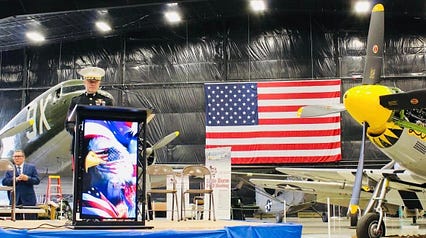 |
Use of military rank, job titles, and photographs in uniform do not imply endorsement by the Department of the Navy or the Department of Defense.
Trygve’s Substack is free today. But if you enjoyed this post, you can tell Trygve’s Substack that their writing is valuable by pledging a future subscription. You won't be charged unless they enable payments.
| ||||||||||